I. Background
- (a) SC.1 is invited to adopt the recommended conceptual and functional specifications and submit them to the Inland Transport Committee (ITC) for endorsement;
- (b) The recommended specifications and the revised UN/CEFACT data standards will be made available as UN public goods, ensuring they remain non-obligatory but widely accessible;
- (c) Governments will encourage anyone wishing to develop an eCMR application to use these UN public goods while – if possible - designating a body responsible for certifying applications based on these recommended specifications / standards;
- (d) The recommended conceptual and functional specifications will remain dynamic, with future amendments considered within SC.1 discussions. Informal online meetings may be convened as necessary;
- (e) A transformation period from paper to electronic CMRs will exist. Its timeframe will depend on many factors, national or international and therefore cannot be fixed. The Group and therefore SC.1 can only encourage every possible user to start using applications developed based on the recommended specifications and data standards ensuring a smooth and efficient transformation from paper to electronic CMRs always ensuring that the CMR Convention applies.
II. Introduction – Historical Review
III. Definitions
IV. Users and roles
- (a) The eCMR “Users” are those defined in the Convention meaning Carrier, Consignor, Consignee. They have the right to create an electronic consignment note, change the data in the electronic consignment note based on the provisions of the CMR Convention as well as provide instructions, requests and comments at the different parts of the electronic consignment note again based on the provisions of the convention;
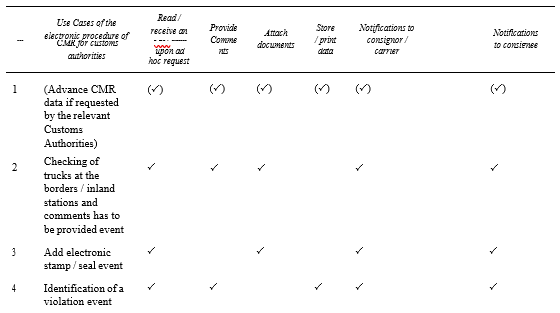
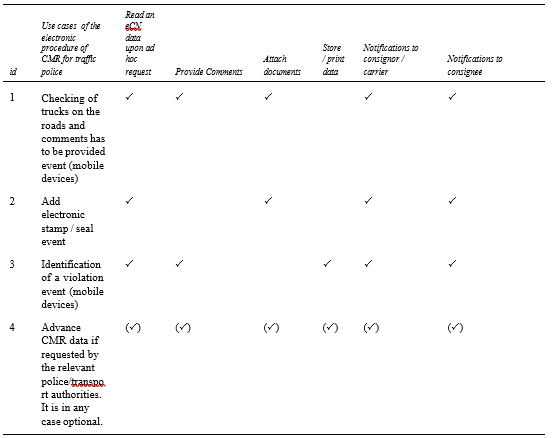
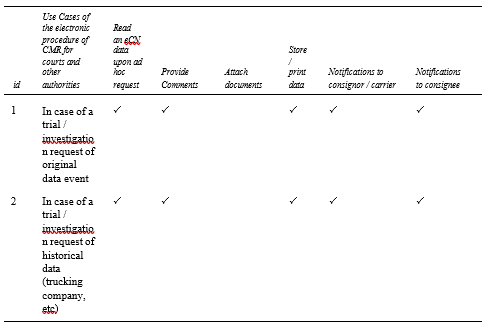
- (b) The Public Authorities that have the right only to read the data of a specific electronic consignment note upon request while exercising their official duties in the context of customs and other formalities (such as roadside controls, control of cabotage, etc.). Beyond this access right foreseen in the CMR Convention, they may need to provide comments related to a specific Consignment Note, in order to fulfil other obligations stemming from their national legislation. These users indicatively could be the customs authorities, the police / frontiers guards, courts, and other entities1.
Footnote:1 The CMR Convention makes specific reference to customs / frontier traffic. For instance, article 1, paragraph 5 “The Contracting Parties agree not to vary any of the provisions of this Convention by special agreements between two or more of them, except to make it inapplicable to their frontier traffic…..”
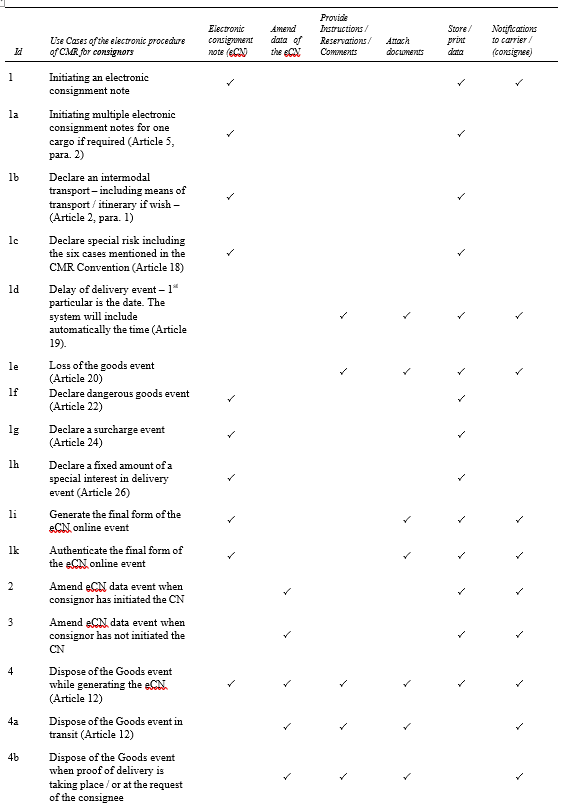
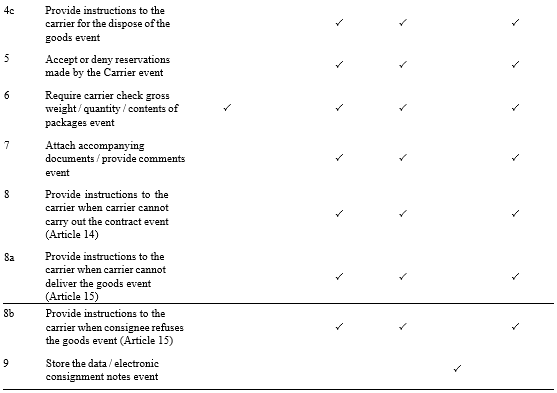
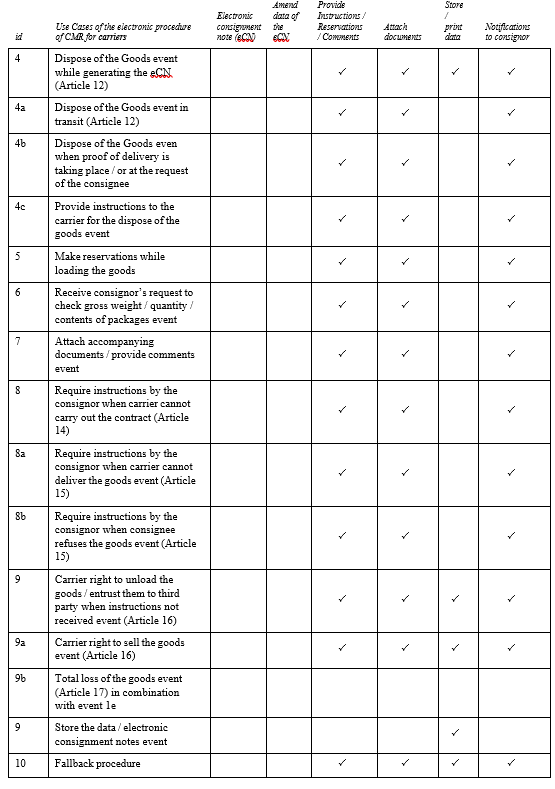
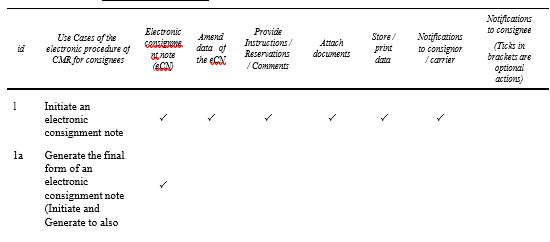
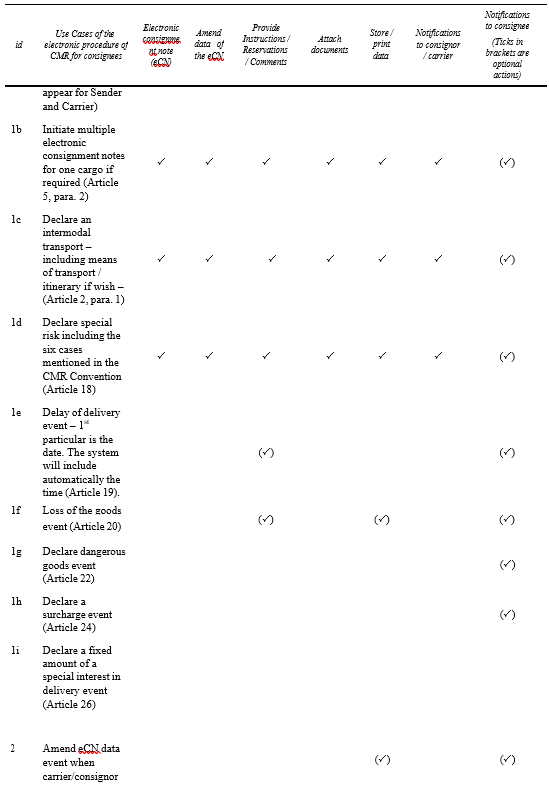
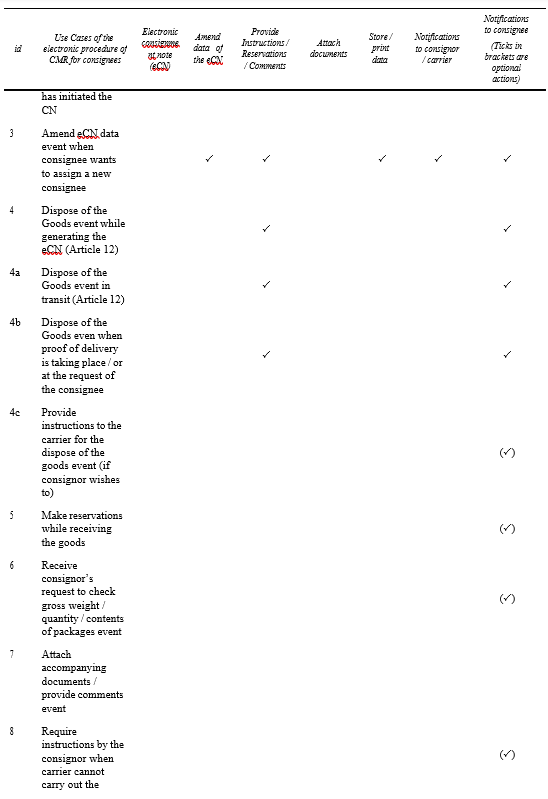
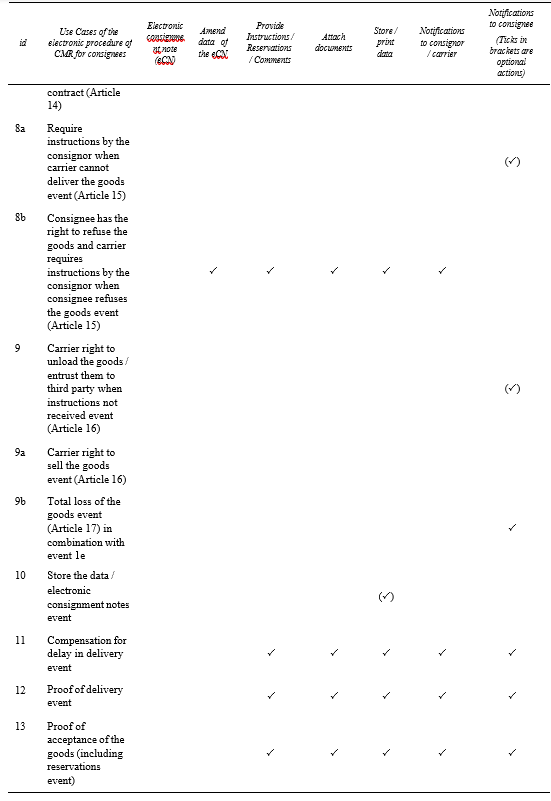
1. The eCMR Users of the electronic consignment note have the right to create and amend the data including provision of instructions, requests, comments, attaching of documents and storage of data
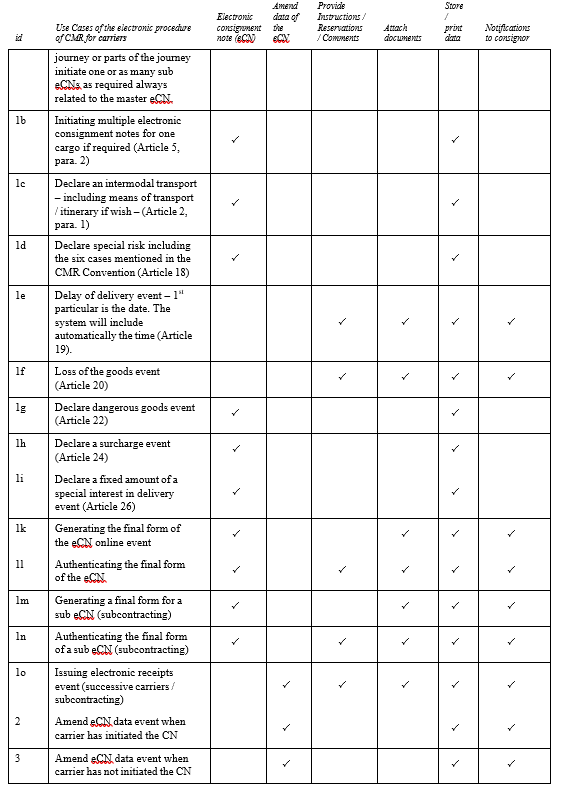
- (a) The initiator of the electronic consignment note has available several digital functionalities that ensure the application of the CMR Convention provisions:
- (i) To initiate several consignment notes if the goods have to be loaded in different vehicles or are of different kinds or are divided into different lots (Article 5, para. 2 of the convention);
- (ii) To use the eighteen particulars listed in Article 6, paras. 1 and 2 of the CMR Convention as far as warranted and add in the electronic consignment note any other particulars which the issuer of the consignment note may deem useful (para. 3).
- (b) To declare the special risks inherent in one or more of the following circumstances where the carrier could be relieved of liability (Article 17 and subject to Article 18, paras. 2–5)):
- (i) Use of open unsheeted vehicles, (specification of the agreement to use unsheeted vehicles – art 17 para 4 (a) CMR Convention);
- (ii) The lack of, or defective condition of packing, (para 4 (b) indication of this risk);
- (iii) Handling, loading, stowage or unloading of the goods by the sender, the consignee or persons acting on behalf, (para 4 (c) indication of this risk);
- (iv) The nature of certain kinds of goods, (para 4 (d) indication of this risk);
- (v) Insufficiency or inadequacy of marks or numbers on the packages, (para 4 (e) indication of this risk);
- (vi) The carriage of livestock. (para 4 (f) Indication of this risk).
- (c) To perform intermodal transport and declare as such in the consignment note as long as the vehicle containing the goods is carried over part of the journey by sea, rail, inland waterways or air and the goods are not unloaded from the vehicle (Article 2, para. 1, CMR Convention);
- (d) To declare the expected time/date of delivery. Article 19 defines the delay of delivery. The system should automatically generate to all parties involved, “a delay of delivery” notification when the expected date of delivery has been reached and a. no delivery processes as described below have been activated in the system b. no actions have been taken including provision of comments [ eCN change/update] for possible delay and change of date of delivery;
- (e) To be notified for the loss of goods (Article 20, paras. 1–4):
- (i) If the goods have not been delivered within thirty days following the expiry of the agreed time-limit – date of delivery – or if there were no agreed time limit, within sixty days from the time when the carrier took over the goods, the system should automatically declare the loss of goods and notify all parties;
- (ii) Based on this notification the person entitled (the party that has the right of disposal of the goods at that point) could make a claim (implementation of Article 27, para. 1 / Article 32, para. 2). A “make a claim” digital functionality might exist;
- (iii) In the course of the year following the payment of compensation if the goods are recovered, the carrier should notify the person entitled through the system. Again, such digital functionality might exist;
- (iv) Within thirty days following the above-mentioned notification, the person entitled as aforesaid may require the goods to be delivered to him against payment of the charges. The person entitled should make this request in the system following the notification received;
- (v) The Carrier shall be entitled to deal with the goods if none of the above-mentioned conditions are met.
- (f) To declare the dangerous nature of the goods to the carrier (Article 22);
- (g) To declare against payment of a surcharge to be agreed upon (Article 24), in the electronic consignment note a value for the goods exceeding the limit laid down in Article 23 / additional protocol to the convention;
- (h) To declare in the electronic consignment note against a payment of a surcharge to be agreed upon, a fixed amount of a special interest in delivery in the case of loss or damage or of the agreed time-limit being exceeded (Article 26, para. 1).
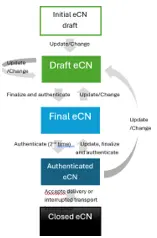
Footnote 2 Each eCN should be versioned (before and after finalization).
Only the latest authenticated version of an eCN should be considered legally valid.
Upon each eCN authentication, the authenticating user should be able to record a remark associated to the authentication.
Upon each new version of the eCN, the Consignor and the Carrier must be notified, and the Consignee may be notified (if he requested to). The only exception being for the author of the eCN change/new version (whether it’s the Consignor, Carrier or Consignee), that would not need to be notified.
2. Public Authorities users of the electronic consignment having the right to read the data of electronic consignment note upon request, and, if required by law, provide comments and store the data